
Saturday, December 24, 2005
Merry Christmas
A friend and client forwarded this email to me. It details many elements of the Christmas season and their meanings throughout history.
Merry Christmas to all, and to all goodnight,
http://www.deerlakemail.com/teach/

Monday, December 12, 2005
Valuation, Valuation, Valuation
I get people fussing with me all the time about the merits of dividend investing. These conversations go something like this: "The bottom line to me is the bottom line on my account statement," they say. "Dividends might be real money and be predictable, but they are not what makes a good investment. A good investment is one I buy low and sell high. Price growth and only price growth matters to me." If I hear this once a month, I hear it a dozen times a month. I hear it so often that it makes me think, I might have the privilege of working in this business for a long time because this kind of thinking is shortsighted, ill-informed, and costly.
Here's my bottom line. If you don't know what makes a stock go up, what good is the price rise to you. When do you take the profit--too soon, too late, never? The markets being what they are, the price will in time go down, and you won't understand that either. So you will cycle between "feeling" good when the market goes up and "feeling" bad when it goes down and have absolutely no idea which of your feelings is accurate. Moreover, as it relates to feelings and the stock markets, most likely neither of them is correct. Feelings are not facts in investing; not yours, not mine.
To escape the cycle of feelings and get connected to reality, you must develop some understanding of how to value a company. I have spent 20 years trying to do this, and my research shows that for many large companies the level and growth rate of their dividends is the best indicator of value. If you study the relationships between dividends and stock prices, you will be surprised by two things: 1. dividend trends are very consistent and persistent and much less volatile than prices or earnings; 2. and yet it is clear that prices follow dividends and not the other way around.
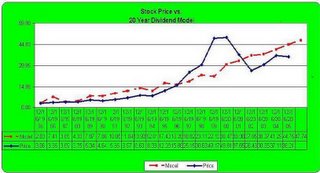
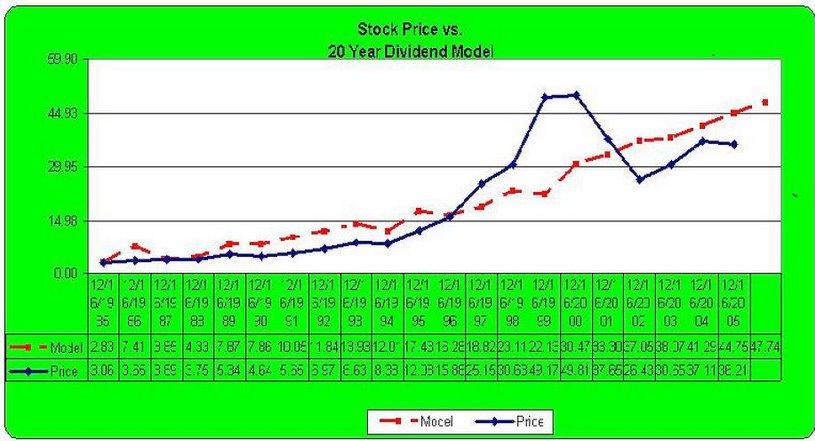
The Dividend Valuation chart below of General Electric is a good example of what I am talking about. The red line is our dividend valuation model for GE over the last 20 years. The Blue line is GE's actual price over this time. Many things are obvious with even a casual glance at the chart: first, the valuation line (red) is virtually a straight line, while the blue line showing price has been all over the road; second, the volatility of price has carried it back and forth across the valuation line; third, buying GE when its price was lower than its valuation line and selling it when its price was above the valuation line has been a near fool proof long-term strategy for the stock. Our rate of return is even better if we buy when price is 10% below valuation and sell when price is 10% above valuation. Finally, the chart shows that the model is signaling that GE is currently selling far below its valuation line, which would suggest it is a good buy. In fact the model is showing that GE is selling nearly 25% below its valuation line. Understanding the model as I do, the only way that the price of GE will now close the 25% gap is if its dividend growth slows dramatically or interest rates sky rocket, neither of which I believe is a strong possibility.
Investing always involves risk, but determining the value of a company keeps you from making emotional decisions that have little chance of success. But of even more importance is understanding value keeps you from getting shaken out of a cheap stock just because the price is going against you.
Someone is always trying to tell me I should be buying this stock or that one. When I ask why, the answer is almost always the same: "Because it's going up." Looking at the chart below, there were a lot of people who were touting GE in 1999, who are still underwater. But there is good news. By my calcuation, they will be back to break even in 2007.
-------GE Dividend Valuation Chart-------
Friday, December 02, 2005
UTX -- Of Horses and Hoods
I'm going to provide a look under the hood of one of our stock valuation models using United Technologies (UTX) as an example. Since 1988 the combination of UTX's dividend growth and the change in interest rates on a 10 Year US T-bond have explained 92% of the annual price movement of the stock. That model currently estimates that the current fair price range should be between $60 and $70 per share, with $65 being the midpoint of the range. UTX is now selling for $55 per share.
At today's price that puts UTX at as great a discount from expected value as at anytime in the last decade. But does that mean it is a table-pounding buy? Yes and no. The expected price range is well above UTX's current selling price, but a look at UTX's history shows that it has had periods of under and over valuation lasting up to 3 years. I fully expect UTX will reach $65 per share over the next few years, thus the question in my mind is not if, but when.
If UTX reaches $65 in the next year, it will produce a total return of approximately 18%; if it takes two years, we will make a little less than 9%. The reason I believe the odds favor UTX reaching $65 sooner rather than later is because UTX has already been undervalued for the past 12 months, so the averages are in our favor.
I just spoke to the company last week and tried to pry out of them what their dividend hike in 2006 might look like. They were noncommittal, except to say a dividend hike was likely in the first quarter. I told them they had enough free cash flow to choke a horse, and I thought their shareholders would applaud, another big dividend hike and a public statement about future hikes.
The company representative with whom I spoke was so used to talking with Wall Street analysts, who completely ignore dividends, that he seems a bit startled when I told him I would rather have the dividend hike than share buy backs.
I mentioned that I had read where the company was disappointed that its stellar 2005 results had largely been ignored by the market, I suggested that a commitment to a dividend payout ratio of 35% would do wonders for the stock price. He was a very pleasant man and said he would pass on my suggestion.
Let's put this one on our radar and see what the next dividend hike looks like. UTX is in our Rising Income Portfolio. Illinois Tool Works, which has a very similar story, is in our Blue Chip Growth Portfolio. I'll review it next.
Wednesday, November 30, 2005
The Evansville Client Dinner -- It was a Blast
Donaldson Capital held its annual client appreciation dinner in Evansville last night. The event was held at the Evansville Museum of Arts and Science. We ate a wonderful meal surrounded by beautiful art and artifacts. Everything went great except for our Texas friends hanging their coats on a piece of contemporary art, which they mistook for a coat rack.
Mike Hull offered our thank yous to clients old and new and shared a bit of our strategy for the future. I cut my speech in half at the request of some of the oldtimers, who said the wine, hors d'ouevres, and conversation were more fun than speech making. I have to agree, but I still got my 8 charts on the wall which showed some of the research that we have conducted on dividends and their correlations to prices.
It was a great night, and the only person I saw nod off was JWB (he's heard it all before). For those of you who were there, that is the reason I had to pick on him a little. He's promised to get his beauty rest next year.
Blessings to all of you. You are our only reason to be. You humble us with your kindness and your trust. We are deeply honored to serve you.
As I said earlier, we will be having other dinners in cities where we work in the months ahead.
Monday, November 28, 2005
Christmas Will Come
The Dow Jones has rallied almost 800 points since mid-October to stand at near 10,900 and many of our clients have asked why? Not that they don't appreciate the bounce, but they question if the news has really improved as much as the rise in prices now reflects.
First, let me remind you that our most reliable model has been pegging the value of the Dow at near 11,800 for most of the year, so a part of this bounce is based on stocks having gotten very cheap, especially when you consider that earnings and dividends have grown at double digit rates. I don't believe that stocks will rise to 11,800 is a straight line, but I do believe there is a high probability that the path of stocks will intersect that level within the next year.
The main reason stocks are doing better, though, is as a result of the economic data that have been released since the conclusion of the Gulf Coast storms. It resolves many of the questions that we cited in our October quarterly letter that need to be answered. 1. The US economy, contrary to the doom and gloomers, has not been materially affected by the storms , and certainly is not headed for recession. 2. Oil prices have softened dramatically to $57 p/bl, down from over $70 p/bl. 3. Inflation spiked in September, but was flat in October. With oil at the current level, November's reading is likely to be tame, as well.
The market is now rubbing the worry beads over the Christmas selling season. I'm not as concerned about Christmas sales as most. My friends in the retail business have told me for years, that everyone always worries about the Christmas season because it is such a big deal to total retail sales in such a short period of time. But they say not to worry, Christmas always comes. It is a part of our culture.
Terrorists, hurricanes, tornados, war, oil shocks, political battles -- all these forces show us just how precious and fragile our lives really are. Christmas and Hanukkah remind us that there is Someone bigger and wiser than us, Someone who has blessed us down through the ages in spite of our folly and the vicissitudes of nature.
Giving gifts to someone we love is as natural as breathing. Do we stop breathing because of the forces we face? Certainly not. Indeed, we will give more purposefully, perhaps more generously, because we will see the faces of those we love, and we love to see them shine. And shining faces have been in short supply during the past many months.
I also encourage you to give to faces you do not know or love. These faces may have borne the brunt of the storms or man's inhumanities to man. A gift from a stranger is almost too good to be true. You will likely never see the face of a stranger light up when they unwrap your gifts, but you know as well as I do that the shine will come -- it's a part of every culture, a part of being human. And you will become a blessing and blessed in the same moment. How can you beat that deal?
Wednesday, November 23, 2005
Thank You
The pastor of my church ends each service with a beautiful blessing:
"May the Lord bless you and keep you; may He make His face shine upon you, and be gracious to you; May the Lord lift up his countenance upon you and give you His peace. Numbers 6: 24-26.
At this Thanksgiving season, I want to express to you how grateful all of us at Donaldson Capital Management are that you have chosen us to work for you. You are a blessing to us. We are honored by the trust that you have extended to us, and in everything we do, we seek to be worthy of it.
Happy Thanksgiving,
Greg Donaldson
Sunday, November 20, 2005
Dividends Talk -- GE -- What More Can They Say?
GE announced a 14% dividend hike last week. As usual the news of this hike was like a piece of juicy gossip. It traveled all around the world before Chairman, Jeffrey Immelt, could get the whole sentence out of his mouth. **Not**
No, the truth is the news of the dividend hike did not even make some financial websites that I watch. And yet, in the few words it took to announce the hike, GE said more about the coming year than a stack of Wall Street research reports. Before I discuss the implications of GE's dividend action, let me show the blog I wrote on December 13th of 2004.
December 13, 2004
So goes GE . . . .
GE's announcement of a 10% hike in its dividend this week is very good news. GE has long been a bellwether of the US economy, and the double digit increase is a plus not only for GE, but also for the entire US economy and stock markets. CEO Jeffrey Immelt also announced future earnings growth in the range of 10-15%%. We believe this guidance says three things: 1. Earnings will grow faster than 10%, 2. Dividends should also grow at least at 10%, and 3. Average US profit growth should be also close to 10% over the next few years. More importantly, GE's dividend and earnings growth pronouncements allow us to compute its intrinsic value. Starting with a dividend of 86 cents,growing at 10% per annum over the next five years then gradually slowing it to a long-term growth rate of 6.0%, all discounted at 9%, produces an intrinsic value of just under $42.00. We think its just a matter of time before the stock trades there. It is currently trading at $37.26. This is the best news on dividends I have seen in a long time. GE is so big and so important to our economy that their guidance sheds a light on the whole economy. Well done Mr. Immelt.
GE had been wallowing around ever since Jack Welsh left the throne, and the 10% hike, to me, was a clear indication that Mr. Immelt was signaling that things were about to get better.
With regards to the three things I said the dividend hike was implying, (1) GE's earnings, indeed, will be above 10% for 2005, at near 13%;(2) The 10% 2005 dividend hike is now being followed by a 14% increase for 2006 (I continue to think 10% will be a floor for the next several years); and (3) US corporate earnings growth will be near 14% for 2005, well above my projection of 10%, which was 50% higher than Wall Street consensus estimates.
The only part of the December 2004 blog that has not come to fruition yet, is GE's price. I said in the December blog that our dividend model was producing a present value of $42.00 for GE. Well, not only is GE not trading at $42 per share, it is actually trading at $36 per share, lower than it was last December 2004.
If you are a momentum investor, you don't care a twit about talking dividends, or valuation. You care only about price, and "what have you done for me lately." But if you are a dividend-value investor, you know that prices and values can disconnect for long periods of time, but sooner or later GE is going to not only trade at $42 per share, but it will also trade at $47.00, which is what our dividend model says it is now worth.
In my judgment, GE is the most important company in the United States. They are very large and so diversified that they are a bit of a microcosm of our entire economy. If GE is upping its dividend and earnings targets for the coming year and thereafter, I believe it is unwise to be too pessimistic about future economic and profit growth for the whole country .
The terrorists cannot stop our economy, the hurricanes cannot stop our economy, even the blood sport that the politicians are playing cannot stop our economy. A year ago the best clue we could have used to tell us the shape of things to come was GE's dividend hike. I think you can do the same today. The only difference is I strongly believe GE's price will catch up with its valuation over the next 12 months.
Subscribe to:
Posts (Atom)