
Showing posts with label Bond-Like Stocks. Show all posts

Friday, May 03, 2013

Citizens of Bondsville: Welcome to Dividendsville

Many in the financial media are wringing their hands that the current bull market in stocks isn’t acting right.  "It’s too defensive," they say.  Put another way, they believe the wrong kinds of stocks are leading this bull; therefore, it is not to be trusted.  Nothing could be further from the truth.  One day these growling bears will admit they are wrong and come charging into this bull market.  That will be the sign for us believers to know it’s time to leave.  But, our guess is that time is a long way off.

The right stocks for a normal bull market are the so-called cyclical stocks – Basic Materials, Financials, Consumer Cyclicals, Industrials and Techs.  These kinds of companies sell products that last for three years and longer.  An uptick in these sectors of the stock market would mean that new incremental buying is occurring in these “long-term” sectors and would mean that big employment gains should be very near.

The leaders of the current uptrend in stocks are the defensive stocks – Consumer Staples, Healthcare and Utilities.  Companies in these sectors sell products we buy and use every day -- think of Procter and Gamble as the epitome of a defensive stock and Caterpillar as its counterpart.  One can’t put off the purchase of Crest toothpaste nearly as long as they can put off buying a new D9 earth mover.

Today’s bull market is not a classic bull market from the perspective of what kinds of companies are leading the pack, but it is a bull market nevertheless.  The easiest way to think of it is as an asset-allocation shift bull market.  As the Fed has continued to keep interest rates near zero, more and more investors have decided to flee their poor treatment in Bondsville to head for better returns in the suburbs.  They have traveled through the nearby communities of Junk Bondsville, Preferred Stockville, and - in recent months - have been moving into Dividendsville.

They have said, “I would rather take the risk of owning the common stock of Procter and Gamble or McDonalds than accept a 1.6% taxable return from a 10-year U.S. Treasury Bond.”

Certain types of large, multinational stocks are now being seen as having less risk than U.S. Treasury bonds.  The math is simple:  On an after-tax, inflation-adjusted basis the 10-year Treasury is a sure loser over its lifetime.  That’s not even considering the sad shape U.S. Government finances are in today.  On the other hand, Procter and Gamble (PG) and McDonalds (MCD) are companies that have taken on all comers and are not only still standing, but prospering.  Both have dividend yields near 3%.  

PG has paid a dividend since 1891 and raised it for 59 consecutive years.  PG’s dividend has risen at an annual rate of over 8% during the last three years and over 9% in the last five years.  At an 8% growth in its annual dividend, PG’s dividend will double in nine years.  Even if PG’s stock price does not move a penny over the next nine years, its dividend yield will rise to 6% - based on today’s price.  Its internal rate of return would be about 4.5% from dividends alone.
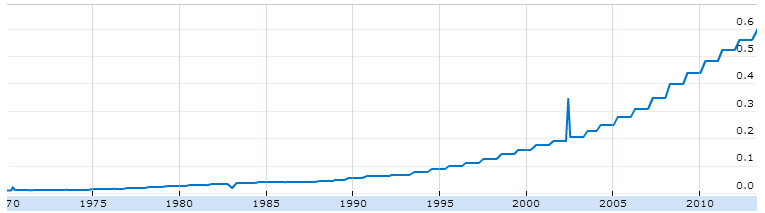
Proctor & Gamble (PG) Dividend since 1970
MCD’s dividend growth of near 12% per annum over the last three years and 3-5 year projected growth rate are both higher than PG’s.  

Procter and Gamble and McDonalds are not the only members of Dividendsville.  There are nearly 100 (and growing) companies worldwide that are becoming viewed as being safer than governments.

You won’t find these kinds of companies standing in line for government hand outs.  Indeed, it is the taxes these companies pay year after year that the U.S. government is so anxious to give away.

These companies cannot create income through taxation, but they can do something even better – compete.  They balance their books every year.  They navigate the byzantine regulations in every country in which they do business.  They hire and train employees for jobs that have a future.  They innovate.  They take risks.  They give back to every country and community in which they do business.  And - most importantly - they build flexibility into their decision-making that allows them to be profitable nearly every single year. 

Compared to bond yields, the current dividend yields of PG, MCD, and a host of other similar companies are actually higher than they should be.  If the current slow growth economy continues through the end of this year, we believe dividend yields for these kinds of companies will fall to nearly 2.5%.  For dividend yields to fall despite rising dividends for these companies, it would mean their stock prices would have to rise 15% or more between now and then. 

This might seem like an overly aggressive view of the performance potential for these stocks, but there is a line forming in the heart of Bondsville that stretches as far as the eye can see.  They are leaving town.  Whether or not they know it now, they will find their way to Dividendsville.  When they do, they will never leave.   


Our clients and staff own MCD and PG.

This discussion is provided for information purposes only.  Please consult your investment advisor concerning any ideas expressed here.  

Wednesday, June 20, 2012

Bond-Like Stocks Are Still Winning


We regularly slice and dice the S&P 500 to determine what general categories of stocks are doing well.  Periodically, we do what we call a strategy check.  Simply put a strategy check is an analysis of the three or four investment criteria that we believe are at the core of our Rising Dividend investment strategy.  The following is a brief discussion of the criteria we follow most closely and how companies with those characteristics have fared over the past twelve months.

Quality:  As we have detailed many times in these blogs, our investment selection process begins with the quality door.  Except on rare occasions, we invest only in companies whose bonds achieve at least an investment grade rating by one of the major rating agencies.  The reason for this is obvious:  sooner or later, tough times come, and when they do winnings stocks are almost always found among companies with good credit histories and ratings.

The following are the 12-month median total returns of the S&P 500 companies broken down by ratings.                  


Rating
Median Total Return
AA-AAA
12.8%
A
4.8%
BBB
4.0%
B-BB
-10.5%
NR
-1.8%
Standard and Poors 500 Index
3.72%

The last twelve months have been a roller coaster ride for stocks of monumental proportions.  In this kind of environment, it is not surprising that the higher quality stocks have performed well versus lower rated stocks.  It is a bit surprising that the total returns by bond rating are so symmetrical.  As we have noted before, the stocks in our Cornerstone investment strategy have an average bond rating of A+.  


Dividend Yield:  After a stock makes it through the quality door, the first thing we look at is its dividend yield.  Dividends are cash money.  Dividend payments place a premium on a management team that focuses on the proper balance between the cash flows necessary to pay the dividends and the capital expenditures necessary to keep the cash flows growing.  In short, dividends require a disciplined management team.  We think this means that most companies who pay a regular dividend are less likely to be taking wild-eyed fliers with our money. 

Dividend Yield Quintiles
Median Total Returns
Top 100 Dividend Yielders
8.2%
2nd 100 Stocks
4.7%
3rd 100 Stocks
2.4%
4th 100 Stocks
3.8%
5th 100 Stocks
-1.6%

It is not surprising that the median returns of high yielding stocks are showing good results.   Bond yields are historically low, and people have been moving to higher yielding stocks in a steady stream.  What is surprising to us, again, is that the results are nearly symmetrical.  We believe this might be a cautionary signal.  Many high yielding stocks we see on the list of top performers have very little dividend growth and are presently borrowing money to pay the dividend.  That is not a good sign and could signal some dividend disappointments in the year ahead.  That is the reason we focus so intently on dividend growth. It is the best way we know that a company can offer tangible signals about it future prospects. Talk is cheap, but dividend hikes mean a company's money is where its mouth is.

Dividend Growth:  We learned a long time ago that dividend yield alone is not enough; dividend growth also plays an important role in the long-term performance of a stock.  The following tables show the median total return over the past 12 months of stocks in the S&P 500 sorted by dividend growth quintiles. 

Dividend Growth Quintiles
Median Total Returns
Top 100 Dividend Growers Last 12 Months
4.8%
2nd 100
5.9%
3rd 100
7.6%
4th 100
2.5%
5th 100
-8.1%

The table shows that investors have not rewarded the top dividend growth companies that are located in quintiles 1 and 2.  Investors have been buyers of the lower dividend growers in quintile 3.  A closer look at that group is very revealing.  The average dividend yield for the stocks in quintile 3 is 3.4% and the average annual dividend growth is 5.9%.  This compares to the S&P 500 where the dividend yield is approximately 2%, with dividend growth last year of near 10%.  

It is important to note, that while quintile 3’s slower dividend growth was the top performer, quintiles 1 and 2 also outperformed the S&P 500 total return of 3.7%.  That is also the the case in our Cornerstone investment strategy.  The 30 stocks in that portfolio have a current yield of 3.5% and dividends grew last year at just under near 10%.        

Our bottom line summation of what this strategy check is telling us is that, indeed, in this low interest-rate, slow growth environment our concept of “bond-like” stocks is still a winning strategy.  The markets are rewarding higher quality over lower quality.  Investors are buying dividend yields that are higher than bond yields and are favoring current yield over dividend growth, although companies with high dividend growth are outperforming the average stock.  We have spoken about these bond-like stocks in several previous blogs.  Please access these links,1. Bond-Like Stock Audio, 2. Bond-Like Stocks, to see and hear a more expansive discussion of why we believe this concept is working and will continue to work.


Friday, February 10, 2012

To Dividend or Not to Dividend, That Is the Question?

To dividend or not to dividend, that is the question?  In 2011, most of what we have been saying about dividend stocks for the last 15 years came into full view for everyone to see.  In a weak stock market, the cash payments distributed by dividend-paying companies were more highly valued than betting on the come with the non-dividend payers.  During most of the year, the dividend yields of many stocks were higher than the yield on a 10-year U.S.Treasury bond.  This fact alone lifted many consumer staple, energy, health-care, and utility stocks.  Taken as a group, dividend-paying stocks significantly outperformed non-dividend paying stocks.

In 2011, dividend-paying companies, particularly those that have a history of consistently raising dividends, gradually were seen to be bond substitutes.  This is due to the compounding effect of rising dividends.  A company with a 3% dividend yield today will be yielding 6% in ten years if its dividend grows at a 7% annual rate.   A company yielding 2% today with its dividend growing 12% per year will yield near 7% in 10 years.

During the year, dividend paying stocks became the equity asset of choice.  There was almost a perfect symmetry between dividend yield and total return:  The higher the stock's dividend yield, the higher was its total return for the year.  For example many utilities enjoyed total rates of return of 15% or more in a year when the S&P 500 grew by about 2%.

But here in 2012, the robust early gains for the S&P 500 (5%) and the Global Dow (10%) have presented investors with a very difficult question:  Do we continue to focus on the "knowns"of dividend investing, or do we abandon them for the  "unknowns"  of gut feelings and hot tips?

The reason this question is so important is because the impressive stock market gains in the new year have caused many strategists to raise their estimates of 2012 stock market performance to 15% or more.  A 3% dividend yield looks good in a 2% stock or bond world, but it does not stack up so well against 15% returns.  Because of this many articles have been written arguing its time to move away from dividend investing and start pursuing growth again.

We would argue that dividend paying stocks are likely to perform just as well as non-dividend payers, even if stocks rise by 15%.  The reason is simple, our valuation models now predict that the average stock in our portfolios, which has a 3.5% dividend yield, is undervalued by almost 25%. You must remember, we focus on rising dividends.  To achieve a steady stream of rising dividends, a company must also have a solid stream of growing earnings.

In short "To Dividend or Not to Dividend" may be a false question.  Dividend-paying stocks can offer market-type returns when stocks grow by up to 15%.  In our experience, dividend-payers only begin to lag the overall market when the S&P 500 grows by 25% or more.  Even then, they will get most of the gains.

Considering how well the dividend payers do in down markets, and in view of all of the uncertainties in the world, we still believe "To Dividend" is the right answer for most people.    

We own dividend-paying stocks.

Wednesday, August 10, 2011

Are Dividend-Paying Stocks Becoming Better Than Bonds?

Speculators are throwing stocks around like dead fish, but even a simple analysis of companies in the S&P 500 shows that they are very much alive.  There are now 214 companies in the S&P 500 that have a dividend yield higher than the 2.10% yield of a 10-year US Treasury bond. 

These 214 companies have an average current dividend yield of 3.70%.  Importantly, as an indicator of their vitality, these companies have increased their dividends by an average of 8.20% over the last 12 months. This level of dividend hikes is eye-popping when considering that the US economy grew at only 1.60% during this time.

For the S&P 500 as a whole, the current dividend yield is 2.25%, also higher than the 10-year Treasury bond.  But when including the additional 286 companies whose yield is lower than the 10-year Treasury bond yield, or pay no dividend at all, the average 12-month dividend growth has been just over 14.0%.  During the same time, earnings for the S&P 500 grew by close to 12%.  That means that companies actually grew their dividends modestly faster than their earnings were growing.  Would dead fish companies do that?  Absolutely not.  A company would only hike its dividend at a faster rate than its earnings if it was completely confident that it would not need the money later.

So we have another one of those conundrums here.  The average company in the US is reasonably optimistic about its future.  We would add that the Wall Street analysts agree.  Last Friday, the analysts raised 2012 earnings to new all-time highs.  Thus, at the very time when the speculators were beginning to sling dead fish like there was no tomorrow, the analysts were pushing up 2011 and 2012 earnings. The actions of the analysts are vitally important in solving the conundrum:  It was almost exactly a year ago when the analysts also went against  the fish tossers by continuing to hike earnings for 2010 and 2011 even though stocks were selling off.  We all know now that they were right.  Earnings and dividend increases kept on rolling in and stock prices exploded.

We are not completely discounting the action of the fish tossers.  There certainly is a foul smelling odor coming from Washington these days, and the puny growth of the US economy stinks; but we believe speculators are missing the bigger picture.  World-wide economic growth is projected to be near 3.5% for 2011.  That rather spritely figure includes the smelly slow grow rates in the US and Europe.  The truth is the developing world is still showing solid growth, and, of equal importance, the developing world is a lot bigger than most investors understand.

In previous blogs we have extolled the concept of bond-like stocks.  Our view is for many companies the current dividend payments are very safe; indeed, we believe they will grow at solid rates over the next few years.  Mathematically, a stock yielding 3.7%, with its dividend growing at 7%-8% should clobber the current 2.10% return on a 10-year US Treasury bond.  It is not a guarantee, . . . but perhaps in light of recent events, we might say that questions have been raised about the credit quality of US Treasury bonds, as well.

Thursday, October 07, 2010

Utility Watch: Still Waiting For The Breakout

As I said last time, we are watching the utility sector for clues about the future course of stocks overall.  The good news is that last week the Utility Sector (XLU) made a new 2010 high.  The not-so-good news is that its price did not exceed the December 2009 high. 

Utilities are a key indicator because they possess two important qualities.
  1. History shows us that they usually lead stocks out of bear markets and corrections.
  2. They are in the category of bond-like stocks that has been doing very well in recent months.
The bond-like qualities of utilities may be the most important indicator in the current market.  Bond prices continue to surge, with the 10-year T-bond now yielding under 2.5%.  By contrast, the current dividend yield of the utility sector (XLU)  is approximately 4% and, according to Bloomberg, has produced dividend growth of over 5% per annum over the past five years. 

I was modestly disappointed that XLU did not pop north of the December 2009 high in last Friday's big up move.  However, hot markets do not usually draw lots of investors to the slow-moving utilities; thus perhaps Friday's action should have been expected.

Another reason I am so interested in the utilities is that they are widely owned by individual investors.  A continuing uptrend in XLU would suggest that individuals may be accumulating their old faithful sector.  The other old-faithful dividend sector, banks, has completely betrayed the individual investor with dividend cuts and continued turmoil. 

If the utilities keep moving higher and break above their old high, it would not stretch the imagination to think that they might continue to move higher than most people now believe.  The reason is simple:  There are not many sectors of the stock market that have treated long-term investors very well in recent years.  The old favorites, health care and banks, have both let investors down over the last decade.  Only the utilties have provided a solid return during this time.

Our Dividend Valuation models are suggesting that utilities are as much as 25% undervalued.  Maybe just maybe, this industry has it affairs enough in order that they will pierce their 2009 highs and break into new territory.  That is what we are counting on.

Sunday, September 19, 2010

Southern Company Looks Undervalued

We believe many high quality, dividend-paying companies are very attractive compared to US Treasury bonds.  We have previously described the concept we call "bond-like" stocks.  Bond-like stocks to us mean companies that
  1. Have strong balance sheets 
  2. Have a history of paying dividends
  3. Display a history of raising its dividends,and
  4. Possess dividend yields that are close to the yield on a 10-year US Treasury bond.  
 We have previously written about two such companies, Procter and Gamble (PG) and Royal Bank of Canada (RY).  The third stock in this series to meet the bond-like stock criteria is Southern Company(SO).  SO is one of the nation's largest electric utilities, and we believe it has a lot going for it that is being ignored by investors.

Our Dividend Valuation Model above (click to enlarge), which is based on the relationship between SO's price versus its dividend growth and the level of interest rates on long US Treasuries, suggests that the stock may be undervalued.  Indeed, the model is projecting that the total return of SO over the next 12 months may approach 17%.  As we always say, our model is based on historical relationships and thus is certainly not a guarantee of the future, but we are inclined to believe that SO is positioned to do well over the next year.  Here's why:
  1. SO's bonds are A rated by both rating agencies, among the highest rated utilities in the US.  
  2. It is the second largest utility in the US and the largest in the Sunbelt, where the population is still growing.
  3. SO has a near monopoly in its service areas and produces power through a diverse array of power sources from coal to nuclear power.
  4. SO has generated a 14% annualized return over the last 10 years, far outpacing the S+P.
  5. The company has paid a dividend since 1948, and its current dividend yield is just under 5%.
  6. SO has raised its dividend for 9 consecutive years at an annual rate just over 4%.
Our conclusion:

SO sells a product necessary for our daily lives and is as well run as any utility in the US.  It has a current dividend yield of nearly double that of the 10-year Treasury bond.  SO's implied return of 9% (5% dividend yield plus 4% dividend growth) compares favorably to the 10-year Treasury yield of 2.75%.

We believe the recent aversion to risk that has gripped the markets can not last forever. As investors realize that they cannot live very well on CDs paying .3%, they will begin looking for quality alternatives, and the first place they will look will be the electric and natural gas utilities.  When they start looking at the utilities, it will be hard to beat what they find in Southern Company.

Clients and principals of Donaldson Capital own SO.  Please see Term and Conditions of this blogsite on the right sidebar.
                                

Saturday, August 14, 2010

Royal Bank of Canada is the Epitome of a Bond-Like Stock

In these uncertain times, we are asked over and over by our clients : "How can I invest in the stock market with less volatility and more predictability?"  Our answer is: "By investing in Bond-Like Stocks."

Bond-Like stocks aren't for everyone, but once you get to know them, you might find they are just what you have been looking for.  In our last audio blog (see link) we introduced the concept of Bond-Like stocks.  These are stocks that have very high financial strength and credit ratings, a dividend yield higher than that of a 10-Year US Treasury bond, and a history of raising their dividends. 

Royal Bank of Canada (RY) probably fits these criteria as well as any stock I can think of.  Here are the particulars for RY.
  1. RY is one of 5 AAA rated companies in the world.
  2. Its current dividend yield is 3.9%, much higher than the 2.8% yield on a 10-year T-bond.
  3. It has raised its dividend an average of 10% per annum over the last 10 years.
In addition, RY, along with all the other Canadian banks, largely escaped the subprime crisis as a result of its conservative lending practices.

A look at Royal Bank of Canada's most recent earnings report reveals some very interesting data points.
  1. Quarterly allowances for loan losses were 48% lower than a year ago.
  2. Shares outstanding were almost flat, very different from big US banks which increased shares by up to 35% to meet government mandated net capital requirements.
  3. Total loans grew modestly, again contrasting the shrinking loan balances at most US banks.
  4. Perhaps the most striking data point was RY's return on equity (ROE).  ROE for its second quarter was near 17%, almost as high as its 10-year average and almost double that of the big US banks.   
At the above right is our proprietary Dividend Valuation Mode for RY (click to enlarge).  The model suggests that the company may be as much as 14% undervalued, based on the year-ahead dividend growth we project.  As we have said before, the Dividend Valuation Model is based on historical relationships of price versus dividend growth and changes in interest rates.  These relationships may not hold true into the future, but on a historical basis the model has been able to predict the annual movement in the price of the stock at near 90%.

We'll have more to say about Bond-Like stocks in the coming weeks.  Next time we'll describe the hidden value of rising dividends.
Clients and principals of Donaldson Capital Management own RY.  See the conditions for use of this blog site at the right.