Thursday, May 18, 2006

Market Comment

A number of our staff has been in Tuscaloosa and Birmingham Alabama over the past few days visiting clients and our friends at the regional TD Waterhouse office. Yes, we were telling our dividend story, but we were also sharing our views on the economy and stock markets. On Tuesday night at a gathering of clients and prospects, I asked for a show of hands on three questions regarding inflation: (1) Inflation is a big problem, (2) The Fed has done its job and inflation is reasonably under control, and (3) Inflation is overstated and will diminish in importance quickly. As I told the group, I had my own opinion, but I was interested in what they had to say. The vote was 50% for #1, inflation is a big problem and 50% for #2, inflation is under control. No one asked me to vote, but I would have voted for #2, inflation is under control. I told the group that the dead-even split appeared to be consensus of the investment community. The reason for this is contained in Chart-I.

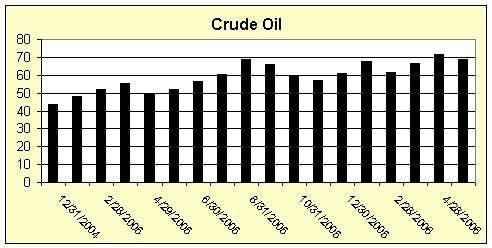
There are two graphs on the chart. The green (dark) line is nominal or headline CPI, which measures the actual rate of inflation, and the brown (light) line is the "core" CPI, which excludes food and energy from nominal CPI. The core CPI is what most economists watch because food and energy are very volatile and can distort the data when viewed too narrowly. Chart I shows that the nominal CPI has been on a steady march higher since the end of 2001. Core CPI has been much steadier, spending most of it time between 1.5% and 2.5% over the last 9 years. Interestingly, the 80 year average of both indices is near 3%, and this is the reason that the Fed and most economists pay more attention to the core rate of inflation. It is less volatile than the nominal CPI and, in the long run, it has increased at the same rate. Yesterday almost $200 billion was chopped from the value of the S&P 500 because both measures of inflation were slightly higher than forecasts. The nominal CPI was .6% for April and the core CPI was up .3%. Most experts expected nominal CPI to be a big number because oil prices had risen nearly $5 per barrel in April but forecasted that the core CPI would come in at .2%. So in a manner of speaking a .1% miss on the core CPI was worth about $200 billion in stock values. The reason the stock market reacted so negatively can be understood by looking again at ChartI. The core CPI has gone sideways at near 2% annual growth for the last year. It has done so in the face of a big increase in oil prices and some food commodities, and the effects of Katrina, et al. The problem is the .3% increase in the core CPI for the month of April has now turned the nose of core CPI up. If core CPI is, indeed, moving higher, then the Fed will continue to push rates higher and the recent rally in stocks will stall. The reason is simple: even though first quarter earnings have been outstanding, at least some of the rally in recent weeks, has been based on the notion that the Fed was nearing completion of its rate hikes. I am not in the camp that believes that the Fed has a lot of work left to do, and the reason can be seen in Chart II. Chart II shows the monthly price of crude oil since 12/31/04. The most recent three bars of the data are the key drivers of the inflation story in the short run. The last bar on the right hand side of the chart shows today's price for oil of $68.80 per barrel. The data that was released yesterday reflected the nearly $5 per barrel run up in the price of oil for the month of April, which ended the month at $71.9. Since the end of April, prices have fallen about $3 per barrel. If this price decline holds through the end of the month, May's CPI data will be much lower than the just-reported numbers for April.
But, even if oil prices stay high, I believe inflation will stabilize and begin to fall in the months ahead for three very big reasons: (1) It is well known that Fed rate actions work with a lag of 6-12 months. Thus, the effects of their recent hikes have not yet been felt by the economy. (2) There is little doubt that the hot real estate market is cooling. A slowing real estate market will slow the economy and diminish price increases in housing related raw materials, which have been rising sharply in recent years. (3) The effects of higher oil prices, while affecting inflation, also impact economic growth. The reason is simple: higher energy prices come right out of consumer's pocket books, leaving them less money for other discretionary spending.

Additionally, substitution is starting to take place. As I write this letter the CEOs of the major auto manufacturers are in Washington DC lobbying for more filling stations across America capable of pumping grain-based alternative fuels. There is, obviously, a lot of politics in the promotion of alternative fuels, but, in my judgment, it has now become clear to leaders of all stripes that our country cannot continue its dependence solely on oil rationed to us by countries who are our enemies.

One sign that things are changing was the recent announcement by Archer-Daniel-Midland that they had hired a former Chevron executive as their new CEO. ADM is the leading player in the ethanol alternative fuels market and giving its top job to an oil executive is not a publicity stunt. They see a change in the winds and they are moving to capitalize on it.

Other anecdotal evidence that consumers are changing their buying habits is news that big SUVs are not selling well, and that high mileage used cars are bringing remarkable prices. CNN reports that a year old Toyota Prius is now fetching a higher price than when it was new, even with 20,000 miles.

Inflation concerns will continue to be the driver of both stocks and bonds until nominal CPI falls below 3%. And, while I am not claiming that inflation is whipped, a final look at Chart I shows that, even with the recent bad CPI data for the month of April, nominal CPI appears to have peaked and is now trending lower. Couple this with the falling oil prices in recent weeks and the inflation picture becomes a lot brighter.

Finally, even factoring in higher interest rates, our valuation model for the blue chip indices are suggesting that stocks are underpriced.

I will continue with the third call from Black Monday 1987 soon.

Friday, May 12, 2006

The Rising Dividend Story -- Call #2 -- The Bond Purchase

After finishing my call with Mrs. H., I received a telephone call from a friend and fellow employee of the Indianapolis based investment firm I was with at the time. He was a broker, and I was in the money management department. He explained that he needed a bid on some Indiana University bonds for a customer who was panicked by the crash and wanted to sell. I asked him why he called me and not the bond desk. As he put it, the bond desk was “shut down.” Actually, what was happening was that the stock market crash overloaded the quotation systems, and no one knew for sure if the prices we were seeing on our Quotrons were current or hours old. Under normal circumstances, municipal bonds trade with a spread to US Treasury bonds. The collapse in stocks had caused a flight to the perceived safety of Treasury bonds, thus the prices of municipal bonds like IU’s should have been rallying along with Treasuries. But correctly valuing municipal bonds in the middle of the stock market crash was next to impossible because, again, no one was sure if the prices on our Quotrons were accurate, and no one knew if the normal spreads between Treasuries and municipals were holding. As a result, many bond desks at firms across the country had almost suspended operations. When I heard the news that our bond desk was not bidding on bonds, my heart sank. This was a proud and prosperous firm. To effectively shut down the bond desk was shocking to me, and opened my eyes to how big the crash was. It was starting to shut down the whole system. Shutting down the bond desk was like the power company shutting down one of its generating plants. The only reason they would do it was to salvage the system. Stocks were collapsing and bond desks nationwide were shutting down. Momentarily, I was seized with the notion that maybe this was, indeed, another 1929-type crash and everyone would lose everything. I had to practically shout at my ruminations that this kind of thinking was not true. The economy was strong. Furthermore, only about 25% of the American people owned stocks. They would wake up tomorrow, brush their teeth, eat an Egg McMuffin, drink a cup of coffee or a Coke, get in their car, and drive to work. Life would go on. My friend said that the seller of the bonds was a long-time client who was convinced that a 1929-type depression was imminent and wanted to hold cash. My friend said, he really needed the favor. He needed a bid on the bond because the client was intent on selling and the bond desk could not help him. I told him I could not do favors with other people’s money. He said he didn’t mean a favorable bid; he just wanted a bid, any bid he could show his client. I asked him, “If the bond desk doesn't know where the market was trading, how was I supposed to know?” He said he understood the problem, but that he had nowhere else to go. He thought that since I bought bonds for the firm’s money management clients that maybe one of them would be interested in his client’s bonds. He was in luck by mentioning this last point. I had several clients tell me during the day to keep an eye out for bargains on bonds. I told my friend that I would think about it, and that he should call back in 45 minutes. I also told him that if he could sell the bonds somewhere else he should do so since I was unsure I would make a bid. By law, the State of Indiana cannot have direct debt. The law was the result of the Wabash and Erie Canal debacle of the 1840s, which forced the state into bankruptcy and produced an 1851 statute prohibiting any future issuance of debt by the state. The law was still in effect, and the prohibition against debt meant that Indiana had one of the strongest financial conditions of any state in the nation. As I thought about the bonds, I realized that Indiana University was as close to state debt as you could get. The good citizens of the Hoosier state would sell off their family jewels before they would let Indiana University go under. In addition, Bobby Knight and his Indiana Hoosier basketball team had won the NCAA championship the preceding March, and the state would have probably sold off the capitol rotunda rather than give up the basketball arena. The bonds were safe. The only question was…what were they worth? The toughest hurdle to get over in valuing the bonds was that they were 20 years from maturity. As I thought about it, however, I realized life and taxes would go on no matter what happened in the crash, and that the tax exempt interest the bonds paid would always be prized by investors in high income tax brackets. I knew that US Treasury bonds had started the day yielding about 10.25%, and I knew that bond prices were rallying, so the yields were probably near 10%. I remember thinking that if I could buy the IU bonds to yield 10% that I had a real bargain, and one that I was comfortable making. The broker called me back and I told him I would buy the bonds to yield 10%. I told him to call the bond desk and get their approval before he told his client about my bid. The head of the bond desk called me immediately and tried to explain what was going on with the bond market and his inability to bid. I stopped him and told him that I was aware of what was going on, but the broker had asked me to make a bid, and if he approved it, I was willing to buy the bonds. He said he thought that 9% might be a better level for the bonds. I told him he was welcome to buy them there, but my bid was 10%, and if he did not think it was fair, I was fine with dropping the whole matter. He said he had learned through my broker friend that the client wanted the bonds sold by the end of the day, and that he could find no one else to bid. I told him my bid was good until the close of business. He said he would call me back right away. The broker called back in minutes and said the bond desk would not approve the 10% level. I said that that was fine with me. He stopped me and said, “but they will allow it at 9.40*%.” I told him if his client would take it, I would buy the bonds at that level. I then called the bond desk and told them I would offer a bid on any other bonds that people wanted to sell. I had budged on my level, but I realized that buying Indiana University bonds when no one would make a bid was sure to be a good buy, ultimately. The destruction of hundreds of billions of dollars by the crash was a deflationary event, and I was convinced that this would cause interest rates to fall. As I returned to my blinking phone, I paused for a moment. Something had happened here -- something that was new to me; something that I had never done before. I had just valued a bond in the absence of a trading market. I had just committed my clients to up to 20 years of ownership of this bond, and I had done it in the middle of a panic unlike anything I had ever seen. But what surprised me the most was, as I said earlier, that it moved almost in slow motion and almost intuitively I was able to clear away all of the clutter surrounding the decision and zero in on just the few details I needed to make the decision. *This is my best recollection of the final level. I know it started at 10% and the bond desk asked that it be lowered. I have checked the records as far back as I can, but the company has changed hands twice and no one seems to know where the old records are.

Monday, May 08, 2006

The Rising Dividend Story -- Call # 1-- Mrs. H.

When you pass through the waters, I will be with you; and when you pass through the rivers, they will not sweep over you. When you walk through the fire, you will not be burned; the flames will not set you ablaze. Isaiah 43:2. A friend of mine gave me a daily prayer journal just days before Black Monday. I sat at my desk before the market opened that morning, and seeing the prayer journal, I opened it to October 19. The above verse from Isaiah was written across the top of the page followed by blank space for personal observations. When I saw the passage, I realized how much I needed to hear those words this morning. The financial storm that was Black Monday had demolished the Japanese and Europeans markets and within minutes would slam ashore here in the US. I tried to collect my thoughts and take a few minutes to meditate on the scripture, but the phones had begun to ring and my thoughts were not collectible. I just bowed my head and uttered, “Lord, give me your strength and your wisdom.” I said last time that I received three calls during the day that changed my perspective of investing forever. Two were from clients; the third was from a colleague. The first call came from a client. Mrs. H. was (and is) a remarkable woman. She had given birth to twelve children. She and her husband had built one of the largest farming operations in this part of the country, and after her husband died, she added coal and oil to her business interests. She was a delightful lady, and I had had the privilege of working with her in municipal bonds for many years. Around midmorning, she called and waited on hold for several minutes. When I was able to get to her, I was surprised to hear her voice. Thinking she was worried about the market’s effect on her holdings, I started into my Black Monday talking points. Mrs. H. was surprisingly direct. She asked how much money she could borrow from her account. I read the amount to her, which was in the hundreds of thousands of dollars. She said that she had been listening to the radio and knew that the market was down over 200 points and wanted to buy some stocks. I was surprised to hear that she wanted to buy stocks because, normally, she bought only municipal bonds. I had no doubts Mrs. H. was of sound mind and meant what she said, but I did not think buying into the crash was a good idea. I told her that in my opinion the day’s selling would likely be followed by more selling, and it might take weeks, even months, before the markets could put in a solid bottom. I told her I thought buying into the crash was very risky. She then became more direct. She said that she had watched her husband accumulate thousands of acres of prime farm ground by buying when everyone else was selling. She had continued that strategy after he had died, and it had always eventually resulted in large gains. I tried to get a word in, but she continued. She said, “Greg, I know what I am doing, and I am a big girl. If I am wrong and it doesn’t work out, I won’t blame you. And while I have no intentions of losing this money, if I do, my life will not change.”I asked her, “If your decision is final, what would you like me to do?” She said, “Erwin always bought when everyone else was selling, but he only bought the best ground. I want you to give me a list of what you consider to be the best companies I can buy; companies that are going to come out of this bad market stronger than they went in. That is what I saw my husband do time and time again, and that is what I want to do now.”In all the years I had worked with Mrs. H, I had rarely heard her speak of her husband. I don’t believe I knew his name before that day. I realized in the span of a few minutes a very successful person -- a self-made person -- had shared with me a priceless bit of investment wisdom. Everyone says the secret to success is to buy low and sell high. Hardly anyone, however, invests that way. Most people really want to buy high and sell higher; they have no appetite for buying low, because when prices are low, times are usually tough and tough times call for tough minds. She told me how much she wanted to spend and asked me how long it would take for me to come up with a list of companies. I told her I was swamped, but that I’d pull something together by 1:00 PM. Then I asked the only intelligent question I would ask during the entire conversation. “Mrs. H., are you thinking of buying these stocks to take a short-term profit if the market bounces back, or are you thinking of holding them for awhile?” She said, “Greg, I want to buy companies that I can own for the rest of my life. That’s the way I buy farm ground, and that’s the way I’m thinking about these stocks.” In between calls, I kept thinking about which stocks were the “best.” Words like: “test of time,” “blue chip,” “high quality,” “powerhouse,” “winner,” and “sure-fire” passed through my mind. What did it mean to own the best stock? I realized that before the crash, my definition of the best stock was the one that made the most money in the shortest time. But I quickly realized that this way of thinking about “best” was only possible by looking back. In this case, Mrs. H. wanted to know the best company on a present and forward-looking basis. She was not asking me to pick a company with the best value, she was not asking me to pick a winner; she was just asking me to pick a small group of the best companies. The more I thought about it, the more I realized that there was no answer to her request. There was no such thing as the best company. There were companies that were great values, and companies with the best risk/reward ratios, but “best” was just too relative of a term to apply to companies. For a while I thought I’d have to tell her I could not help her. Then I thought about what she was asking me to do according to her perspective in the world of farming. I had grown up in a farming town. I had friends and relatives who were farmers. If I were to ask them what the best land in their county was, I knew they would have an answer. They would use terms like lay of the land, richness of the soil, length of the rows, and width of the fields. They would consider access, creeks, out-buildings, and locations. But this line of thinking was not helping either; farm ground was tangible, stocks were intangible. Was anything tangible about a company? Stocks possessed a book value, but it was not what truly gave most companies their value. Book value was just a measure of the value of the means of their production. What gave a company its value was how much its products and services were prized by consumers, the company’s ability to successfully extend their products to new markets, the company’s profitability, and how good the company was at bringing new products to market. Then it hit me. At the county fair, the best animal wins the blue ribbon; the most attractive girl in the beauty contest wins the crown. A man gives his best girl a diamond. A great athlete becomes a star. In all societies, the best are given the prize and are prized. So what companies in the US were most prized? Immediately Coca-Cola came to mind, then Disney (it was a much different company then than it is now), General Electric, Wrigley, and Johnson & Johnson were also prized. They were not just blue chips; they were icons that had stood the test of time, defeated all comers, were very profitable, and had star quality. As I ticked down through their qualities, I realized that they were what some people called their “brand.” The strength of a brand was as close as a company could get to being tangible. I called Mrs. H. back and gave her my line of thinking and the shortlist of names. I asked her one more time to wait a few days. The market was coming apart and I told her that I had no idea where these stocks were trading. She agreed. We did, however, start to buy some of the “best” stocks by the end of the week. It still did not feel right to me, but it was what she wanted. Sure enough, just as she had predicted, eventually almost all of her “best” stocks did very well. I spoke to Mrs. H. this week and asked if I could tell this story. We had a delightful converstation. She is 84 years of age. She recently remarried – in a barn – to a man she met bowling. “He’s a great guy,” she said. I would say you could bank on that. The second of the three important calls on Black Monday was from a colleague and friend who had a problem. Next time I'll describe that call.

Friday, April 28, 2006

The Rising Dividend Story -- The End of the BIG Trend

As I said last time, the crushing of my BIG Trend investment strategy didn’t knock me off balance as much as it put me into slow motion. It was as though everything around me moved in the frames of a filmstrip. I’m not saying I didn’t feel anxiety or worry. I did; but it did not bother me that I didn't know what I was going to do next. That was because I knew that I was going to sit tight until the storm blew over. If any companies were going to weather Black Monday, the companies we owned would. After all, they were still big, growing, industry leaders; and by the end of the day, they would be 23% cheaper. Their rising price trends were devastated, but they were not going to just dry up and blow away. The phone calls poured in that morning, and didn’t relent the entire day. I spoke with nearly every client I served. Sometimes, up to four calls waited at one time. I was running so far behind because every time I hung up the phone it rang again. I ended my last call of the day around midnight. Surprisingly, people remained relatively calm, considering the circumstances, and agreed with my decision not to sell into the crash. As I spoke with each person, a type of “Black-Monday talking points” started to emerge in my mind. I was convinced from watching the action of the market that the collapse was, at least in some way, a structural problem. The normal interaction between buyers and sellers was corrupted. I believed this because of the wild swings in stock prices. As an example, on Black Monday, General Electric opened 15% lower than its previous close. It then retraced the entire loss, before falling again by 25%, a swing of over 50% for the day. GE was a one hundred-year old company that produced a wide range of products that people all over the world used everyday. There was no way the fortunes of this company could change that much in a day. As I thought about it, GE’s price swing for the day was wider than it was in a normal year. The talking points went on to explain that our portfolios were full of “essential services”: companies such as banks, food and beverage, health-care, energy, transportation, and utilities. I explained that no one knew what these companies would sell for in the coming days and months, but their existence was not in danger. Indeed, because they had strong balance sheets and were already the leaders in their industries, there was good reason to believe that their businesses would improve. I concluded by saying that it was important to remember that we own companies and not stocks. Lastly, the economy was strong going into Black Monday, and it was inconceivable that it could fall apart in a short time. No one listened to the talking points more than I did. My “Price Trend” philosophy was dying with each additional 100 point fall in the Dow. Yet, it was becoming clear to me that the violent action of the market was only marginally connected to the underlying values of most companies. I realized that while the “Trend” part of BIG Trend investing was dead, the BIG part was going to save the day because big companies that were industry leaders and growing were holding up much better than small and highly leveraged companies. While this was good news, I was careful not to offer anyone false hope to the people I was speaking to. I tried to explain to everyone that the crash was going to take a long time to fix. Indeed, it took almost two years. On Black Monday, in the midst of the demise of what I thought I knew about investment strategy, almost outside the realm of my consciousness, a new investment strategy was beginning to take shape in me. On that day, The Rising Dividend strategy was set in motion by way of three phone calls I received. Each one was surprising, and each one went against the grain of the day’s events. In the end, each one helped me see a way out of the wreckage of Black Monday by presenting an opportunity and asking me to consider it from a different perspective. Next time: The Three Calls

Sunday, April 23, 2006

The Rising Dividend Story -- Black Monday

No investment strategy comes to a person's mind fully formed. Neither does it come entirely through the intelligence of a wise professor, or the persuasion of an insightful author. An investment strategy a person is willing to bet his or her life savings on is one that has been molded and tested in the fires of adversity and has shown its mettle and its worth. These pages have been full of stories about the merits of rising dividend investing. Many of you who are reading this blog are sold on this strategy; while many of you may think it is just a clever marketing strategy. During the next few weeks, I would like to share with you the story of how I came to understand the hidden value of rising dividend investing. As you will see, the Rising Dividend Story is really a story within a story. I have experienced this story first hand, but it is not mine. Indeed, I was aware of many of the elements of this story years ago, but it took the keen intellects of Mike Hull and Rick Roop and a book written in 1937 to fully understand the breadth and width of the power of rising dividends. I will retell the story as faithfully as possible. But please do not mistake my telling of the Rising Dividend Story for the truth of it. When the truth of it apprehends you, you will see investing with entirely new eyes. I'm not sure whether telling the story will take 10 installments or 20, but we will work our way along in a logical and chronological way. Many of you who are reading this will find yourself included in the story. So many of you have contributed to the Rising Dividend Story that I am dedicating it to the clients of Donaldson Capital Management. While perhaps not suitable for framing, you may wish to pass the story along to friends and family, especially to young adults. Rising Dividend Investing is not the only way to invest, but we believe it is understandable to almost anyone and it works. It allows a person to disconnect from the frantic search for the next hot tip or hot stock and rest in the knowlege that you own real-live growing companies and not a collection of ticker symbols. The Story Begins Black Monday, October 19, 1987, was agonizing, devastating, and surreal, yet from a long-term investment perspective, it was the best thing that ever happened to me. On that day the Dow Jones Industrials fell by 511 points; 22.6% of its value, which would be the equivalent of over 2500 points today. Black Monday’s percentage loss dwarfed the 12.8% one-day loss in the crash of 1929. When I say Black Monday was the best thing that ever happened to me, I do not mean a kind of Dickinsonian best of times and worst of times happening together. From a financial and psychological perspective for me, it was the worst of times. The only good thing that happened as a result of the crash was the destruction of most of my illusions about investing. If you would have asked me prior to Black Monday what stocks to buy, I had a quick answer and I was convinced I was right. My investment strategy was contained in the acronym BIG trend. BIG stood for Big companies that were Industry leaders and Growing. Trend meant I invested only in BIG stocks whose prices were trending higher. I made the claim regularly that in sticking with big companies I could know as much about them as the Wall Street analysts, because big companies were widely covered in the popular and financial media. In focusing on industry leadership, I was merely stating the obvious; that size mattered, and companies that were number one or two in their industries were generally the most profitable, efficient, and valuable. However, I must have said ten thousand times in my life that there were lots of big companies that were leaders in their industries, but few of them were growing. Thus, the core of my investment strategy was that earnings growth was the dynamo that propelled price growth. Finally, since the markets were made up of very bright people with lots of tools for uncovering successful investments, my strategy was to wait until price trends clearly began to move in concert with earnings growth, giving me what I called convergence, and a probable winner.Once I had convergence, I bought the stock and owned it until its price and earnings diverged. Between the two, the price trend was the final word. It was my theory that the so-called “mind of the market”, the millions of investors making buy and sell decisions, would get into a kind of buzz where everyone was looking at the same price and earnings trends. This would pull more and more investors into the buzz and push particular stocks and industries higher. My approach had been successful for many years. I was confident that if I watched the markets closely enough, I could see which way the winds were blowing and which of them held the most promise. Other than the trend of earnings growth, I paid little attention to the valuations or fundamentals, such as P/E, sales, and dividends. I believed that my best chance of success depended on watching the trends and not the values. On Black Monday, the price of every stock suddenly collapsed. Ironically, the crash was made worse because there was no negative economic or political news that appeared to be fueling it. The market just seemed to implode. The companies I owned in my clients’ accounts were still big, industry leaders, and growing, but not a single one now had a friendly trend. All stocks were headed down. The strategy I had used for years was saying to sell everything, but as I thought about the wisdom of selling all the stocks under our management, I found myself recoiling. It flashed through my mind that it made absolutely no sense to throw good stocks at bad prices. I could feel it in my bones that something was wrong with the markets and not our companies, but I was now faced with the dilemma of ignoring my long-established strategy of selling stocks that had broken rising price trends. At the moment I decided not to sell everything, I realized I was cut adrift from any experiential confidence I possessed. If I ignored sell signals, then when did I sell? And perhaps, if I was not willing to throw good stocks at bad prices, I should be taking advantage of the collapse and start buying. These questions cycled through my mind continuously. As they did, a strange sense of unknowing took up residence in me, and I came face to face with the reality that the BIG trend investment strategy that I had followed for so many years was at an end. Circumstances had shown it was suitable only for “fair weather” investing, and the weather had turned as bad as it had been in 60 years. Yet, having said this, the sense of unknowing was not a feeling of hopelessness or confusion. I had an intuitive feeling that there was no smart way to escape the crash, and the most important thing to do was to keep things very simple and avoid emotional responses both in myself and in my clients. Short of another 1929 depression, the companies we owned would make it through these times, and I knew when things calmed down, they would be the first to rebound. As Black Monday wore on and the telephone calls from frightened clients kept coming, I realized that I had few answers for them. Even if they insisted on selling, the market was running so far behind that the prices I saw on my screen, at times, were an hour behind the actual trading. It was anybody's guess what a person would actually receive for the sale of a stock. A big day for the Dow Jones at that time was a positive or negative change of 20 points. The market opened the day down 200 points before rallying back to down only 80 points by mid morning . When it again fell by over 200 points, something inside of me gave way, and I knew the market was going a lot lower before the end of the day. Lower than I could have ever imagined. As the market continued to fall through each succeeding 100 point drop, I found myself with a growing recognition that the crash would likely do as much psychological harm as financial harm. It also posed a serious threat to the existence of the small investment firm that I had helped start in the previous year. I had been in the investment business for 12 years, and this small investment firm was the culmination of my dreams. This would be a battle not only to protect our investor’s assets, it would also be a battle to save our company.

Sunday, April 09, 2006

An Update of the Dow Jones Regression Model

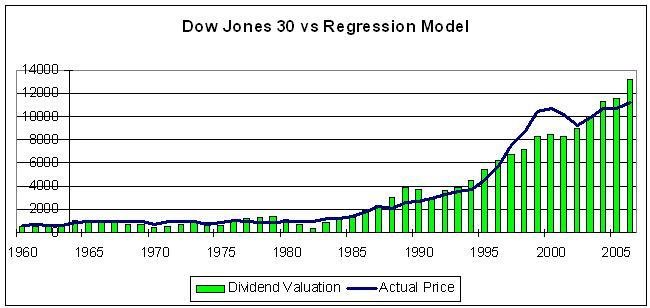
The Dow Jones Industrial Average has been making a valiant attempt to move convincingly through 11,000. The usual list of headwinds--interest rates, oil prices, inflation fears, geopolitical problems --, however, have made progress difficult in recent weeks. But it is important to remember that fourth quarter earnings and dividends grew by over 10%, and this week first quarter 2006 earnings start coming out. Estimates for first quarter earnings growth are in the 11%-13% range. A few basics: The Dow Jones 30 is highly correlated to the fundamentals: earnings, dividends, and GDP. That means that, over time, as the fundamentals have grown, the DJIA has grown. Stocks don't go up in a vacuum. They go higher, as it were, on the shoulders of the profit growth of American corporations. We have developed a handful of models over the years to keep an eye on the fundamental valuations compared to actual prices. I recently plugged in the earnings and dividend estimates from S&P and Value-Line into our model. I made our own estimate of average interest rates for the coming year and then put everything into our model. The chart below shows 46 years of the model's predictions. They have been good. The coefficient of determination is near 95%. Please click chart to enlarge. The regression model shows that the current combination of earnings, dividends, and interest rates produces a Dow Jones of near 13,000. That would seem like a outrageous level and not connected to reality. To ignore the model's high correlation with the actual results, however, would, from a statistical perspective, be irresponsible. The model correctly called the undervaluation of the late 1980s and the overvaluation of the late 1990s. The model is making a rather simple statement: in an interest rate environment such as today, earnings and dividend growth should be more highly prized. When is this valuation gap going to close? I don't think that is as important to answer as to just look at the trend of the late 1980s. Stocks were undervalued for eight years, but rose smartly in concert with the rise in intrinsic value. I think that is likely to happen again. The important thing to remember is that, history shows us, that eventually prices will catch up to valuation. That's now nearly 20% higher than today's market. Forty-five years of high correlations do not a sure thing make, but then again, if we are in the business of buying low and selling high, history says, from a valuation perspective, stocks are certainly not high.

Saturday, March 25, 2006

Conagra -- Able, Willing, and Ready -- Not

Time does not permit me to comment on many individual stocks, but I was recently asked about my outlook on Conagra - CAG and there are elements of the Conagra story that I would like to expound upon, so here goes. We operate on the investment thesis of Able, Willing, and Ready. Because dividends are not guaranteed, answering the Able question tells you what level of risk you are assuming. I learned the hard way many years ago that a high-dividend yield is just another way of saying high risk. Many people who load up on high yield dividend stocks would not buy a junk bond because of its perceived high risk, but from a strict financial perspective, the junk bond has less risk that the high yield stock. Having said this, CAG would seem to pass this test easily, with an A- quality rating from S&P. But we caution, S&P's quality rating is entirely looking backwards, so we move on. Quantifying the Willingness of the company to pay a dividend commensurate with its success is easy. Just look at a table that shows the growth of earnings versus dividends. If they are, indeed, both growing at similar rates, it passes. If the dividend, which is the investor's cut of the annual profits, is traversing a trend that is not related to earnings, beware. Dividend growth that is only a fraction of earnings growth is a complete non starter, but dividend growth far in excess of earnings growth is also a signal that the company might be a little too "willing," shall we say. Sort of like the "painted lady." If she's over-painting, what's she hiding? CAG begins to fade a bit here in its attractiveness. Its dividend has been growing far more rapidly than its earnings. Indeed, before CAG recently cut its dividend, they were paying out nearly 80% of their earnings in dividends. Except for REITs and Master Limited Partnerships, an 80% payout is "unreal," and falls into the category of "its just a matter of time." The Ready stage is about valuation and fundamentals. In CAG's case we don't need to go very far. A look at their earnings over the last 5 years shows flat earnings growth and decreasing sales growth. As a practical matter, a dividend with no visible means of support is really risky business and spins us back to Able. CAG is a solid business, but even a cursory look through the lens of Able, Willing, and Ready tells us that the current business trends are not working and a shake up is coming. In shake ups, the first thing to go is the dividend. Why? Because dividends are real money that is going out the door; while the necessity for a shakeup is evidence, that the quality of the money coming in the door "ain't real good." It may appear like I'm hindsighting CAG, but we have watched its lack of progress for years. I think we may have owned it many years ago, but sold it for many of the reasons identified above. I don't own the stock. This is not a recommendation. Please don't act on anything I have said here. My purpose in discussing this company is to offer insights into the Rising Dividend Investing strategy that we use at our firm. Blessings,