Wednesday, August 01, 2007

Real Estate and Mortgage Woes Do Not Mean a Recession is Inevitable

Yesterday American Home Mortgage, a specialized mortgage company, lost 90% of its value, when its lenders refused to advance the company more funds to meet its reserve requirements and lending demands. When the news was announced, the Dow Jones was higher by over 100 points, after the news hit, the market immediately turned lower and finished down over 100 points, wiping out hundreds of billions of stock market value.

The question that everyone is asking is how much more bad news are we likely to get from the mortgage and real estate businesses, and do their problems have the potential to endanger the banking systems and the economy?

Here’s my short answer. From what I read, American Home Mortgage’s –AHM -- biggest problem was that their banks pulled the plug on them because of the falling values of AHM’s underlying collateral, so it was not necessarily a case of them being swallowed up in sea of bad loans.

The big banks and investment banks in the US, in an effort to protect their own assets, have begun to cut off additional loans to all but prime mortgage credits. This will likely lead to more headlines for specialized mortgage lenders who are forced into bankruptcy because of being cut off by their lenders. So the answer to the first part of the question is the mortgage mess will be with us for a while, yet.

Having said this, I do not believe the odds are very high that the problems of the subprime and specialized mortgage lenders will cause severe damage to the major banks in this country or to our overall economy. My reason for saying this is that the banks in this country entered the year 2007 in as a good a financial position as they have been in 20 years. The best way to look at this is to compare the cumulative financial condition of the major banks at the beginning of 2007 with their condition when they entered the last period of financial stress, which was in the late 1980s—to early 1990s, resulting from the S&L debacle and a severe pull back in corporate profitability.

The table shows that there is little comparison between the financial position of the major banks today and that of 1989.

Today the banks’ equity capital as a % of assets is 60% higher than it was in 1989; non-accrual loans (loans on which the bank is not receiving
payment), at 0.5% of total loans are only about 20% of what they were in 1989; the banks’ current loan loss reserves (money that is set aside to cover potential losses) is 274% of their actual loan losses, compared to 1989, when loan loss reserves were only fractionally higher than actual losses at 102.5%. Finally, At the beginning of 2007, actual loan losses were only 2.3% of equity capital compared to an 11.2% rate in 1989.

The bottom line is the banking system is strong, and I believe it can withstand the current real estate and mortgage problems very well.

The stock market is retreating because of fears that the banking system will be threatened by the current mortgage mess, which will result in a recession for the whole economy.

The best argument against that line of thinking is the aforementioned strength of the banks, but beyond that is recent US economic data. US Gross Domestic Product was just reported to have grown 3.4% (annualized) in the second quarter and the US unemployment rate has remained steady at only 4.5% of the workforce. Remember these data occurred simultaneous with the bad news in real estate and mortgage lending. Finally, if a recession were imminent, the Federal Reserve would have an obligation to start cutting rates.
As I mentioned in my last blog, I listened to the quarterly earnings reports of three of the biggest banks in the country. None of the three reported big jumps in loan charge offs, or greatly increased their loan loss reserves. And, to remind you, two of the three increased their dividends more than we were predicting.

Gyrating markets are not much fun for most people, and they always raise the question: “What are these stock worth, anyway?” If all you are only looking at prices, you might decide that stocks aren’t worth very much, but when you look at companies from the perspective of the cash dividend they are paying and the dividend's rate of growth over the long-term, another picture becomes clear. Many companies are veritable cash flow machines and will be worth more in 10 years than you can imagine.

Cash dividends are real money and determining the value of companies that have long histories of raising their dividends is much easier than it is for companies who must be valued on earnings alone.

As I have said in these blogs before (see my series on The Rising Dividend Story on the side bar)[from the beginning], it was during the severe market correction of October 1987 that our Rising Dividend investment style was born. I knew those dark days would pass because I was convinced the selloff was not fundamentally driven, but I did not know what to buy, and so I sat on the sidelines and let one of the best buying opportunities in the history of the capital markets go by. Now 20 years later, we have a few pretty good valuation tools, and they are signaling that some truly wonderful companies are being put on sale (some of which we already own). I don’t think we need to be in a big hurry, but there are a few that I have been trying to buy for a long time. I’ll be discussing some of those companies in the days and weeks ahead.
Table and data from BCAresearch.com and FDIC

Friday, July 27, 2007

Viewing the Market Selloff from the Perspective of a Dividend Investor

By Greg Donaldson and Mike Hull Yesterday's 300 point loss in the Dow is not the end of the stock market nor the demise of our clients' assets. Every time the stock prices fall like water out of a boot, everyone throws their hands in the air and tries to shield themselves from the pieces of sky that surely must be falling. The sky is not falling, and neither will every bank in America collapse in the face of the housing debacle. Stock prices will gyrate and the media will pontificate on all the things that are wrong, but that is their way -- to fan the fires, so they can sell more kindling. We listened to three earnings calls this week: Wachovia, Wells Fargo, and Bank of America. These are three of the largest banks in the county, and all are deeply involved in the mortgage market. None of these companies said they were seeing big increases in their non-performing credits, and none said that they were experiencing big defaults in their loan portfolios. Two of the companies, Wells Fargo and Bank of America, signaled their confidence in the future by hiking their dividends, 11% and 14% respectively. How can these companies raise their dividends in the face of all this bad news and falling stock prices? Two answers: 1) These companies have strong balance sheets and their earnings are good. They are confident that they will come through this challenging mortgage market just as strong, if not stronger, than they are today. 2) They know that stock prices have nothing to do with their fundamental businesses. We love dividends because they ignore what is going on today. They reflect, in large part, the track record of the company paying them, and they give us wonderful insight into what their leaders believe about the future. This week Bank of America raised its dividend 14%, to $2.56. That means that an investor buying BAC today could expect to receive a yield of 5.4% in dividends over the next twelve months. And, we're betting BAC will raise that dividend by at least 7% per year year over the next decade. At that rate of growth, BAC's dividend in 10 years would rise to $5.12 per share. That would mean that based on today's price of $47 per share, in 10 years, BAC would be offering a yield on today's cost of 10.8% ($5.12/$47). Now let's compare that to a riskless 10-year US Treasury bond. Today the yield on a 10-year T-bond is 4.8%. BAC's current dividend yield of 5.4% is higher, but let's face it T-bonds have no risk, so based on yield alone we would not choose BAC over the T-bond. However, when we factor in the dividend growth of only 7%, which is much less than their dividend growth over the past decade, BAC offers a much better potential total rate of return over the coming decade. We would be much more worried about the economy if the major banks were not in such good financial shape. All three of the banks we mentioned earlier have at least a AA rating, as reported by Bloomberg. These are solid outfits run by seasoned managers. These companies, like so many of our other "Rising Dividend" companies, are attractive just from their dividends alone. However, when you add in the their prospects for future dividend growth, they are tough to beat by pure growth investments. Pure growth investing requires that an investor buy right and sell right because the timing of these two actions determines the entire rate of return. That is why the stock market is correcting right now. For traders, when the markets start to fall like they have this week, they must sell out fast or risk losing all of their gains. With dividend investing, our rate of return is much more a function of the cash flows that we receive while we "own" the stock. Thus, from the perspective of we dividend investors, if we are happy with the dividend growth and financial strength of a company we own, a big selloff in stocks is an opportunity to add to our positions and look for other solid, dividend-paying companies that the market is "putting on sale." The panic of the day will scare the traders and they will do what they always do-- run -- and this correction in the market may last a while longer. In the end, however, cooler heads will do their homework and conclude that many stocks are too cheap, and that the mortgage mess in this country will pass, like all the crises before it.

Wednesday, July 25, 2007

Dividends Talk: Bank of America -- Wow!

Ok, I have been on a 30-day Wells Fargo watch and today's 10.7% increase was much better than I had expected. No sooner had I started to figure out why the hike was as generous as it was when one of our readers announced that Bank of America had hiked its dividend 14%. BAC's 14% hike has the effect of nearly striking me dumb(almost) : either they are complete idiots and a hike of such magnitude is equivalent to paying people to be their friends, or it is an honest signal on their part that their business is getting better, since last year's hike during the the 'good real estate days' was only 12%. I'll say it, so you won't have to: "So, Bank of America, et al, what about this nasty real estate balloon that is crashing against the jagged rocks; don't you see that you are going to lose a lot of money over the next couple of years as you foreclose on all those houses overlooking the Pacific ocean, or the Atlantic ocean, or the Gulf of Mexico. Doesn't that thought make you want to hold on to your precious cash. Aren't you worried that global warming will make West Virginia the new Florida (I'm just kidding here) and all of your so-called Sunbelt loans, shall we say, become 'Wetbelt loans?' Your 14% dividend hike is an insult to the intelligence of the New York Times. They say that banks are in trouble, and that investors should look at China, because it is the new California (I am kidding here, too). May I say in the nicest possible terms, 'Are you nuts?' Do you realize that your dividend yield in tomorrow's New York Times, Wall Street Journal, and Evansville Courier and Press will show 5.34%? That does not compute. You mean that your business is good enough to pay people more than they can earn from a 30-year US Treasury bond and throw in what ever growth you have over the next 30 years for free? You can't fool me. The New York Times is a bastion of capitalism, and if they say banks are in trouble, you are in trouble whether you know it or not. Of course, its interesting that the New York Times did not announce to the world that they were in trouble, too; that readers were abandoning them for the Internet and graffiti on subway walls. I don't remember them saying that they had bought a newspaper in China at the time that you bought a bank there. Maybe, just maybe they are the fools, not you. Maybe, just maybe, your dividend hike is an honest to goodness sharing of your blessings with your shareholders. Naw, surely not that. No one does something for nothing anymore."

Tuesday, July 24, 2007

Dividends Talk: Wells Fargo, Good Very Good

For those of you who have been on the Wells Fargo dividend watch for the last 30 days, the oracle has spoken, and the news is good, very good. Although, the headlines tomorrow will be filled with tales of the woes of subprime loans, mortgage defaults, and the Dow's 200 point fall, there is good news in Mudville. Wells Fargo, which is as deep into the mortgage business as any bank in America, and thus, not only sees the data but lives in it, has raised their dividend by 10.7%. In my previous blogs on this subject, I said anything above a 9% hike would be a signal that WFC believes that a bottom for the mortgage mess is in sight, but more importantly, that they are gaining market share and will come out of this real estate bubble stronger than they went in. That is a remarkable thought in itself, since WFC is already one of the highest rated firms in the US. There will be those who argue with me that this 10.7% hike is not connected to their forward view of their business prospects , but that it is a payback for the past year. That is bunk. Last year, with earnings running in the mid-double digits, they raised their dividend only 7.6%. I said in an earlier blog that that soft hike was one of the reasons that we concluded that the housing slump was going to be longer and deeper than was generally thought at the time. Our thinking then was, if WFC was a bit bearish on their future prospects, that was news because they have had such a great record over the past two decades at gauging the business climate. It is important to note that WFC is not a pure mortgage bank. They now cover the financial spectrum of financial services, so this solid dividend hike is not a pure reflection of the mortgage business. Having said that, their mortgage busines is so big that if they were bearish on this part of their business, it would have resulted in a smaller dividend hike. I'm convinced of that. Bank of America and Wachovia are due to announce their dividend hikes in the coming months. With WFC having put the pressure on them, with this double-digit increase it will be interesting to see the sizes of those companies' dividend hikes. Dividends talk you know. You just have to listen.

Monday, July 23, 2007

Real Estate, the Banks, and the Ugly Brush

In our investment policy meeting this morning the question was raised, what are the leading indicators of a bottoming in the real estate mess. Almost in unison, we all agreed that the best leading indicator of real estate in these bad times is the same leading indicator in the good times, the banks. However you look at it, the banks are the biggest players in the mortgage market. They have the relationships with the homeowners, and they are the primary sellers of mortgage products to the average consumer. What is not well known, is that most banks then sell off their mortgage originations to Fannie Mae and Freddic Mac, the quasi-governemental agencies, thus minimizing their potential losses. As a result of the almost incredible financial shenanigans practiced by Fannie Mae and Freddie Mac in recent years regulators have forced both firms to limit their rates of growth. This has opened the doors for big banks across the country to become more active in the mortgage holding business, as opposed to just the mortgage origination business. Wells Fargo, Bank of America, Wachovia, as well as Washington Mutual and Countrywide Credit have stepped into the gap left by Fannie and Freddie. As a reminder, this is the "traditional"(good credit with down payment) mortgage loan business, not the subprime loan busniess(nothing from nothing). Even though most of these firms have continued to report fairly good earnings, with few alarming upticks in loan losses, investors are painting all of them with an ugly brush. The clear message is that investors believe that the subprime woes will spill over into the traditional mortage business and, at the least, surely these companies got greedy and have a slab of loans they wish they didn't. We are believe that the majority of these firms were able to say no the real estate sirens who were claiming that no price was too high to pay for "that house down the street." They are all survivors, and they must have been aware of how anxious all the private pools of money were to take on these risks. We are betting most of these firms stepped aside and let the greater fools ply their trade, without holding on to too much foolish merchandise themselves. Remember Wells Fargo -- WFC -- is due to report their dividend increase within the next few days. Our call is this: 1. A 5%-7% hike would be a negative sign that would mean that no end is in sight for the real estate troubles.

2. A 7%-9% hike would indicate that the real estate business is wounded, but the bottom is in sight.

3. A hike above 9% would mean that the bottom in real estate is not only in sight, but WFC is taking market share.

We will have an analysis of WFC's decision after their announcement. We will also run a number of banks through our Dividend Valuation Models over the next few weeks and share the results.

Thursday, July 19, 2007

Boeing Is a Dream

The Boeing 787 Dreamliner was introduced to the world on July 8. While you may not have seen much about the new plane in your local newspaper, it may be the most important new product of the 21st century.

The 787 Dreamliner is a show stopper. It is the world's first mostly composite commercial airplane. It will not only use 20 percent less fuel per passenger than similarly sized airplanes, but also produce fewer carbon emissions, and yet offer quieter takeoffs and landings.

The Dreamliner has been so successful in its advance orders that Airbus, its European rival, has suffered some order cancellations for some of its new products.

As Boeing's success with the Dreamliner has become more apparent, the stock has begun to rise. Indeed, it has tripled over the past 4 years. Recently, I have seen many analysts say that Boeing has come too far too fast. I do not agree. Our Dividend Valuation Model for BA shows why.

The Chart shows BA's actual annual prices (blue line) and our model's predicted values( green bars) over the last 20 years. You can see that over the last four years, BA's prices and predicted values have been almost a perfect fit. Therefore the current price of the stock is fully substantiated by the recent dividend growth of the company.

The striped bar to the right is the predicted value of BA based on my year-ahead dividend growth and interest rate predictions. That price is near $120 per share. That would be nearly a 20% increase from the current price of $102.40.

My guess is the Dreamliner will be an even bigger success than the market now believes, and thus, my year ahead prediction may be low. You know I can't see the future and the airline business is a treacherous business, so success is not assured. Having said that I want you to think about Boeing in a little different way.

There are only two major airplane manufacturers in the world, Boeing and Airbus. With the growing global economy, these two companies have what amounts to a toll road connecting every continent of the world. If you want to go to China, you will go on a plane made by Boeing or Airbus. The same for Europe, Japan, and South America. The only way a human being can reasonably travel long distances in on aircraft made by these two companies.

The airline business may continue to be a cutthroat business, but the aircraft manufacturing business is a duopoly. Unless these companies are run by fools they both have a very bright future, especially when the world is clamoring for more fuel efficient planes. Boeing is certainly not run by a fool. James McNerney has a proven track record of turning businesses around and maximizing profits.

There are all kinds of reasons why my optimism might not come to fruition, but I believe there are many more that say it will.

The stock is owned in our Capital Builder investment style.

Sunday, July 15, 2007

Contrary Opinions

By Greg Donaldson and Mike Hull

As we write the Dow Jones Industrial Average and the S&P 500 are hitting new all-time highs. These new highs are coming a little faster than we thought they would, but then our guess on timing is no better than the next guy's -- it's just a guess. However in our June 4th blog we said that, on balance, the primary forces driving the market were likely to push prices higher in the coming year.

We cited the drivers of higher stocks prices would be:

  1. Solid earnings and dividend growth
  2. The market was undervalued according to our Dividend Valuation Model.
  3. Sub-par economic growth
  4. Investor Sentiment was too bearish
Points 1 and 2 would seem to foretell better stock prices, but points 3 and 4 might seem a bit upside down. Sub-par economic growth would not seem to be a precursor of higher stock prices, but if you think about it for a moment, it makes sense. Sub-par economic growth would mean that the Fed could cut interest rates. Last week, retail sales data showed a sharp slowing. Stocks rallied on the news.

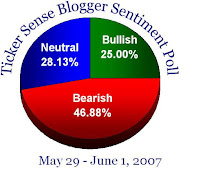
But we suspect one of the main reasons stocks have pushed higher in the face of lots of worries about oil, terrorism, and the sub-prime mortgage mess, was the very bearish tone of investment advisors in late May. In our June 4th blog, we showed the following chart of Tickersense.com's sentiment poll.


Among investment bloggers, many of whom are professional investment advisors, nearly 47% were bearish at the end of May.

We have found, over the years, that such a high rate of bearishness has usually been a positive sign for the market.
High rates of bearishness are often associated with high rates of short sales. A short sale is accomplished by borrowing stock from a broker and then selling it. The hoped for result is that the stock will fall and then can be repurchased at the lower price, thus producing a profit.

But if the short seller is wrong and stocks go higher, to avoid big losses, he or she must buy back the stock to cover or close out the short. The problem is as these short sellers cover their shorts they are doing so in the face of rising stock prices and their purchases provide additional momentum to rising prices.

This will be a big week for the markets. Fed Chairman Bernanke will be giving his semi-annual economic and inflation report to Congress, many companies will be releasing second quarter earnings, and we will getting a fresh look at the Consumer Price Index.

Finally, we are also getting into the season where many important companies will be reporting dividend hikes. We will be detailing some of the surprises here.

The bottom line on all of the balls we have thrown up in the air here, is that we still believe the primary drivers of stock prices are pointing north.