Thursday, July 19, 2007

Boeing Is a Dream

The Boeing 787 Dreamliner was introduced to the world on July 8. While you may not have seen much about the new plane in your local newspaper, it may be the most important new product of the 21st century.

The 787 Dreamliner is a show stopper. It is the world's first mostly composite commercial airplane. It will not only use 20 percent less fuel per passenger than similarly sized airplanes, but also produce fewer carbon emissions, and yet offer quieter takeoffs and landings.

The Dreamliner has been so successful in its advance orders that Airbus, its European rival, has suffered some order cancellations for some of its new products.

As Boeing's success with the Dreamliner has become more apparent, the stock has begun to rise. Indeed, it has tripled over the past 4 years. Recently, I have seen many analysts say that Boeing has come too far too fast. I do not agree. Our Dividend Valuation Model for BA shows why.

The Chart shows BA's actual annual prices (blue line) and our model's predicted values( green bars) over the last 20 years. You can see that over the last four years, BA's prices and predicted values have been almost a perfect fit. Therefore the current price of the stock is fully substantiated by the recent dividend growth of the company.

The striped bar to the right is the predicted value of BA based on my year-ahead dividend growth and interest rate predictions. That price is near $120 per share. That would be nearly a 20% increase from the current price of $102.40.

My guess is the Dreamliner will be an even bigger success than the market now believes, and thus, my year ahead prediction may be low. You know I can't see the future and the airline business is a treacherous business, so success is not assured. Having said that I want you to think about Boeing in a little different way.

There are only two major airplane manufacturers in the world, Boeing and Airbus. With the growing global economy, these two companies have what amounts to a toll road connecting every continent of the world. If you want to go to China, you will go on a plane made by Boeing or Airbus. The same for Europe, Japan, and South America. The only way a human being can reasonably travel long distances in on aircraft made by these two companies.

The airline business may continue to be a cutthroat business, but the aircraft manufacturing business is a duopoly. Unless these companies are run by fools they both have a very bright future, especially when the world is clamoring for more fuel efficient planes. Boeing is certainly not run by a fool. James McNerney has a proven track record of turning businesses around and maximizing profits.

There are all kinds of reasons why my optimism might not come to fruition, but I believe there are many more that say it will.

The stock is owned in our Capital Builder investment style.

Sunday, July 15, 2007

Contrary Opinions

By Greg Donaldson and Mike Hull

As we write the Dow Jones Industrial Average and the S&P 500 are hitting new all-time highs. These new highs are coming a little faster than we thought they would, but then our guess on timing is no better than the next guy's -- it's just a guess. However in our June 4th blog we said that, on balance, the primary forces driving the market were likely to push prices higher in the coming year.

We cited the drivers of higher stocks prices would be:

  1. Solid earnings and dividend growth
  2. The market was undervalued according to our Dividend Valuation Model.
  3. Sub-par economic growth
  4. Investor Sentiment was too bearish
Points 1 and 2 would seem to foretell better stock prices, but points 3 and 4 might seem a bit upside down. Sub-par economic growth would not seem to be a precursor of higher stock prices, but if you think about it for a moment, it makes sense. Sub-par economic growth would mean that the Fed could cut interest rates. Last week, retail sales data showed a sharp slowing. Stocks rallied on the news.

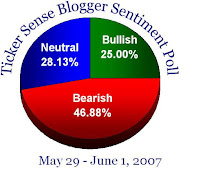
But we suspect one of the main reasons stocks have pushed higher in the face of lots of worries about oil, terrorism, and the sub-prime mortgage mess, was the very bearish tone of investment advisors in late May. In our June 4th blog, we showed the following chart of Tickersense.com's sentiment poll.


Among investment bloggers, many of whom are professional investment advisors, nearly 47% were bearish at the end of May.

We have found, over the years, that such a high rate of bearishness has usually been a positive sign for the market.
High rates of bearishness are often associated with high rates of short sales. A short sale is accomplished by borrowing stock from a broker and then selling it. The hoped for result is that the stock will fall and then can be repurchased at the lower price, thus producing a profit.

But if the short seller is wrong and stocks go higher, to avoid big losses, he or she must buy back the stock to cover or close out the short. The problem is as these short sellers cover their shorts they are doing so in the face of rising stock prices and their purchases provide additional momentum to rising prices.

This will be a big week for the markets. Fed Chairman Bernanke will be giving his semi-annual economic and inflation report to Congress, many companies will be releasing second quarter earnings, and we will getting a fresh look at the Consumer Price Index.

Finally, we are also getting into the season where many important companies will be reporting dividend hikes. We will be detailing some of the surprises here.

The bottom line on all of the balls we have thrown up in the air here, is that we still believe the primary drivers of stock prices are pointing north.


Tuesday, July 10, 2007

A Long-term Look at Dividends and Earnings

The question always comes up, why focus on dividends when Wall Street lives and dies by earnings, and earnings are required to pay dividends? I always admit that earnings are, indeed, theoretically more important than dividends, but earnings share a common trait with stock prices -- high volatility--that diminishes their ability to predict value. Stock prices for the Dow Jones Industrial Average (DJIA), exclusive of dividends, have grown at an annual rate over the last 50 years of 6.7%. During this same time, earnings have grown at an average annual rate of 7.0% and dividends have grown at 5.7%. I admit that the DJIA’s earnings growth of 7% sounds a whole lot closer to it price growth of 6.7% than the 5.7% growth of dividends, so again, why do we say that dividends are the best indicator of true investment value? Volatility, dear reader, volatility and predictability. Since 1957, the DJIA’s price has had an annual standard deviation of near 15%. That means in a normal year, we should expect stock prices to range from -8.3% (6.7%-15%) to +21.7% (6.7%+15%). Thus, it is normal for stock prices to have a down year; about one in three is the historical average. Here’s how dividends win out over earnings in predicting the long-term intrinsic value of the DJIA. While earnings have grown at almost the same rate as stock prices (7% vs. 6.7%), they have been even more volatile than prices. Operating earnings for the DJIA, as calculated by Value Line, have had an annual standard deviation of near 22% over the last 50 years. That means that earnings in a normal year will be somewhere between -15% and +29%, an even wider path of distribution than that of the DJIA’s price. In essence, I think the record shows that earnings’ ability to predict stock prices is not as big a deal as Wall Street makes of it. Indeed, earnings are even more suspect when considering the fact that Wall Street is not very good at predicting earnings in the coming year. Now comes the lowly dividend. Over the last 50 years, dividend growth for the DJIA has averaged 5.7%, but its standard deviation is only about 8%, about half that of DJIA prices, and two-thirds less than earnings. Now we are talking. In addition, during this time, DJIA annual dividends have fallen only 7 times, compared to earnings, which have fallen 14 times. Finally, because dividends are real money returned to shareholders, they have the additional quality of representing nearly 37% of the total return of the DJIA over the long-term. It is the dividend's stability that gives it its power in aiding us in predicting future stocks prices, as well as, to help us to hang in there during the down years. With the recent uptick in interest rates, our fair value model for the DJIA is now 13,800. Interest rates can spoil a summer or even a year, but in the long-run, my work shows that interest rates are not the deal maker. Dividends do best at that role, and as long as dividends are growing faster than roughly 6% (10% this year), I believe stocks are headed higher.

Wednesday, June 27, 2007

Wells Fargo -- The Package is Delayed, but the News is Good

I was hoping to end the mystery of WFC's dividend hike today, as they completed their board meeting and made their usual announcements. I was disappointed to learn that they had pushed the decision on the dividend to their July meeting. My apologies that we will all have to hold our collective breaths for another 30 days to see how much additional cash money WFC will give us in the year ahead. As you remember, my focus on WFC's dividend hike was because they are such a huge factor in the mortgage business and their 2006 dividend hike was a bit light(See my previous Blog). My interest is still keen to see what July 24th will bring, but I believe a partial answer to questions surrounding the state of the mortgage business was revealed in a management change announced today: Richard Kovacevich, the legendary leader of WFC, has stepped down as CEO of the firm and is being replaced by John Stumpf (no relation to our own Carol Stumpf, even though her husband is also named John). I believe this management change should be viewed as good news for WFC and, by extension, their mortgage business. Here's the reason. Kovacevich is a relatively young man of 63. I do not believe he would have willingly retired unless the ship was in pretty good shape. He has built WFC into the premier-earning big bank in the country by thinking very differently about banking and the role of bankers. Indeed, he does not call his branch banks, banks, at all, he calls them stores. His employees are not bankers, but sales associates. He took the idea of "cross sell" to a whole new level. Years ago when he was at Norwest, I remember he had a goal of each "store" customer using 4.7 of the company's products and services -- checking, mortgage, credit card, investments, etc. WFC now has initiative called GR8, where they are trying to cross sell 8, count 'em, 8 products to their customers. Kovacevich would never have built WFC just to turn it over to his long time lieutenant John Stumpf if the "store" was in trouble. He would have ridden out the tough times just as he has done for these many years. In addtion, the board would never have agreed to promote John Stumpf to CEO if they had any worries about the strategy or current state of the bank because Mr. Stumpf has been "riding shotgun" for Mr. Kovacevich for the last 25 years. I take this change in leadership as saying that WFC is not experiencing any alarming acceleration in their loan losses, and by extension, since they are so big in the mortgage business, the troubles in the subprime mortgage business still do not appear to be spilling over to the mainstream segment of the business. Unless there is a health issue with Mr. Kovacevich, I think today's news is good news for WFC, because he will stay on as the non-executive Chairman; and good news to the US economy because one of the biggest players in the mortgage business thinks the times are good enough to make a leadership change. These are just my thoughts on a rainy day in Indiana.

Wednesday, June 20, 2007

Dividends Talk -- Wells Fargo Will Soon Give Us a Reading on Real Estate

In late June of 2006, Wells Fargo (WFC) raised their dividend by 7.7%. This increase was below their trailing 20 year, 10 year, and 5 year average hikes of near 15% per annum. When I first saw the 7.7% print, I thought it made some sense. The Fed had been raising interest rates for two years, WFC's net interest margins were being squeezed, and business was beginning to slow. All these factors would appear to justify a slower dividend growth rate. However, the more I thought about it the more I realized that the weak dividend hike was signalling something more significant. WFC's earnings through the 12 months ending in June of 2006 had grown at nearly 12%, and its earnings and dividend growth had been very comparable for many years. So the 7.7% rate hike required an explanation. When I called the company, I got the distinct feeling that they were trying to explain away the dividend action as though it was no big deal. That was a very different attitude for them to take, because they had been touting their dividend growth for a number of years. As I hung up the phone, I was sure that WFC was signalling a weaker year ahead. Then it hit me. It was real estate. WFC was one of the largest mortgage underwriters in the country. It was a big part of their business. If they were being cautious, it had to be because of they had real estate worries. I discussed my concerns with our investment committee and we agreed the right thing to do was to lighten up on US banks and particularly regional mortgage banks. We also scaled back our holdings of WFC. WFC's June 2006 weak dividend hike, in my judgment, signaled housing was going to be a bigger problem than was generally believed at the time. Twelve months later it is clear that they were right. Next week at their regular board meeting, WFC is set to announce their dividend for the coming year . Here's my impression of what their dividend hike will signal. If the hike is between 5% and 7%, we can expect real estate woes to continue for another year. A 7% to 9% hike would suggest a bottom in real estate is in sight. A hike of more than 9% would mean that they not only see the mortgage business bottoming very soon, but also that they are gaining market share. A dividend hike of under 5% would be a very unwelcomed occurrence. That would mean that WFC is bracing for even more bad news in the housing market. We'll let you know their decision next week.

Friday, June 15, 2007

Dividends Talk

By Greg Donaldson and Mike Hull If you listen very closely, you will find that dividends talk. Indeed, they speak in the universal language of money on the barrel head, not in the wink-and-a-nod dialect of earnings or price. Twenty years ago we began a search for a way to determine the intrinsic value of a stock. For approximately 25% of the S&P 500, we believe we have found it -- listening to the dividends. They talk. Not very much and not very often, but watching their trends over about any 5-year time frame can offer a very good idea of what a stock is worth if you have the right tools. If you include interest rates and, in some cases, earnings, the picture becomes clearer. For the 12 months ending May 31, our Rising Dividend--Cornerstone investment style has experienced the best 12-month dividend growth we can remember, nearly 12.5%. During this time, its dividend yield averaged about 3.25%. If you add the two numbers together, you get 15.75%. That is what we call the Total Dividend Return(TDR). Our dividend theory(and what we believe our Dividend Valuation Models show) is that over the long-term, the total return(price appreciation + dividends) of most consistent dividend payers will approximate its Total Dividend Return. Thus, theoretically, we would have expected that the total rate of return of our Cornerstone style of management over the last 12 months would have been around 15.75%, not the near 19% that it actually returned. A 19% total return when we were expecting under a 16% return is good, right? Well, let's say it's not bad, but not something to get all excited about either, because the extra 3+% was not "earned"in our way of viewing things. You might say it just happened. The question, of course, is isn't that the way all money is made in the stock market, it just happens, doesn't it? Stock returns are random; that is what the dons of academe have been trying to tell us for about the last 40 years. We agree with the dons that in the case of many companies there does not appear to be a value driver, but in the case of consistent dividend payers its a different story. Our research shows that almost all consistent dividend payers have a unique and quantifiable relationship between dividend growth and price growth. Additionally, dividend growth and price growth intersect, or reach a kind of equilibrium about every 3 to 5 years. This means that our Cornerstone's outperformance over the last year can be explained in one of two ways: 1) It is a make up for an underperformance in the last three years, or 2) the portfolio's actual performance will lag a bit until more dividend hikes become apparent. Our best estimate for dividend growth for the portfolio over the next 12 months is just above 10%. With the portfolio's current dividend yield near 3%, that would mean that a good guess of what the Cornerstone portfolio might produce over the next 12 months is near 13%. This strong dividend growth implies double digit returns this year and next. Recently, rising interest rates have been a headwind to almost all dividend stocks, but history shows us that rising interest rates, unless they continue to rise on a secular basis, are not the main driver of very many stocks, even utilities and REITs. The main driver of most dividend stocks is the trend of their dividend growth. Thus, if the trend of dividend growth is sustainable, which we believe it is for many stocks, stock prices will soon stop their swoon and begin to climb again. Here's a real example of Dividend Talk. UTX, which I discussed a few blogs ago, recently announced a 21% dividend increase. The analysts were looking for a 14.5% hike. We think UTX's above trend dividend hike is a clear signal that it is likely to have a better year earnings-wise than Wall Street now is projecting. That means as the year progresses, UTX is likely to find new buyers with each successive positive earnings report. We are awaiting with great anticipation Wells Fargo's next dividend hike. We'll tell you why in a future edition.

Friday, June 08, 2007

Life at Sea

In our recent quarterly letter we explained that one of our core investing principals is that we will invest in only companies that we are willing to hold for 10 years with no option of getting out early. As you know, we do not hold all companies for 10 years, indeed we sometimes sell a company in only months, but the point is on the day we buy a company for the first time, the first question we ask ourselves is, "Based on everything we can see today, are we willing to hold this stock for 10 years." This is not just marketing hype. We mean it, and we learned about this concept from a very unusual source. Many years ago I (GCD) went sailing with a group of colleagues in the Caribbean on a beautiful boat named "Amazing Grace." The captain, who was named Tomas, had escaped from Poland when the country was still behind the Soviet Union's Iron Curtain. Since I was very interested in sailing at the time, he indulged me with tales of his own adventures around the world and what it was like to sail the high seas. I learned a lot about sailing in those few days, but through the stories of Captain Tomas, I also learned something about investing that I believe differentiates us in many ways from other firms. Over dinner one night, I asked the captain if he had any suggestions about what size boat he would recommend if I wanted to get into sailing. He just looked at me and laughed. He said "I have only one rule about boats. I will not set foot on any boat that is going more than 10 meters from shore, on which I would not be willing to spend the night." The dazed look on my face must have convinced him that I did not understand what he was talking about, so he continued. "The thing you have to remember is that sailing is as much about the weather as it is about the boat or the water. Great sailing weather is very close to dangerous sailing weather, and indeed, rough weather, by its very nature, comes fast and hard. In addition, boats that are built for speed are seldom built for sleep. I asked him if he literally meant that he would not set foot on a boat that he was not prepared to sleep on for the night. He answered, "I can't tell you the number of times in my life that I have been caught in rough weather just a few meters from shore. I could have practically thrown a rock and hit the shore, but the winds and the tides were against me, and I was forced to spend hours in high seas until the weather let up and I was able to come ashore. He continued,"Everyone assumes that a nice cruise across the bay, or down the river, or up the coast is what boating is all about. The weather is fine, the light is just right, the sea air is invigorating. Few people take into consideration how big the water is and how little the boat is, even in good weather. But when the bad weather comes, and it always does, in a moment they know they are in trouble, and their only hope is that they and their boat can endure the storm." I told him that his story reminded me of the stock market and people's reaction to it. I explained that too many investors I knew thought the greatest invention of the investment world was the ability to buy and sell, and as a result, they were willing to take a flyer on any idea because, after all, they could always get out. But the truth was when the storms hit the stock market, as they always did, they couldn't get out very easily and certainly not without great cost. Because of this, many investors either became "stuckholders," or traders. He said, "I figured out a long time ago, that my life would be on the water. Almost all of my eating, drinking, and sleeping would be done on the water, and as a result I became more and more particular about the kind of boat I would spend my time on. Gradually, I came to the idea I mentioned earlier of judging the boat by whether or not it and I could survive an overnight storm." He said, "Your story of the "stuckholders" and the traders reminds me of what I call the shorehuggers. They think they are sailing, but they don't have the boat or the experience to go into the deep, and thus, they don't know sailing at all." I asked him what was so important about getting into the deep water. What were the shorehuggers missing? "This little boat ( The Amazing Grace was 60ft. long) has carried my wife and me around the world. . ." He hesitated, and then said,"It's not something I can explain. You'll have to experience it for yourself one day." I never went into sailing. The more I thought about it, the more it reminded me of investing. I already had enough "weather" in my life, but as a result of the discussion I had with Captain Tomas, I began to think about investing differently. It would not happen for a few more years, in some ways not until Mike Hull and Rick Roop came aboard, but eventually, I began to build portfolios that could handle the storms, not try to run from them. Portfolios that ate well, slept well, and performed admirably. Portfolios that could take you around the world, or through the rest of your life no matter what the weather.